Online Garbha Sanskar Guidance
Spiritual nurturing for parents across India
(Prenatal Spiritual Nurturing)
Bokaro & across India
How your online consultation works
Explore traditional prayer, reflection and conscious parenting with our Bokaro-based team. Families across India can enquire about online Garbha Sanskar guidance suited to their stage of parenthood.
Share your questions
Share your stage of parenthood, interests and the questions you would like to discuss.
Confirm your appointment
Confirm online session availability, language, duration, fees and the communication platform with our team.
Join your consultation
Discuss suitable spiritual practices and a comfortable routine. Ask what materials or follow-up are included before booking.
Online spiritual guidance and residential ashram programs are separate arrangements. Garbha Sanskar complements prenatal medical care; follow your qualified healthcare provider's advice about exercise, breathing, nutrition and pregnancy care.
Request an online consultationBefore you book
Can I enquire from outside Bokaro?
Yes. Use our contact page to enquire from anywhere in India. The team will confirm whether your request can be handled remotely and arrange the next steps.
Will the session use Zoom, Google Meet or WhatsApp?
Please confirm the available call or video platform directly with the team. Session fees, duration, language and any WhatsApp follow-up should be agreed before booking.
Explore our articles on Vedic traditions and wellbeing, or learn about Vedic astrology, Vastu guidance and Garbha Sanskar.
The Mother’s Womb:
A Microcosm of the Universe
In the Sanātana tradition, the mother’s womb is regarded as far more than a biological space where a body develops. It is viewed as a microcosm of the universe—a sacred realm in which a new life gradually takes form under the harmonious interplay of nature, consciousness, and divine order.
The child growing within the womb is not merely a developing body; it is a conscious being gradually expressing itself through a physical form. During this sacred journey, the mother’s thoughts, emotions, actions, selfless service, charity, prayers, and values create the subtle environment in which the unborn child evolves.
Just as the vast universe is sustained by invisible laws, subtle energies, and an underlying cosmic intelligence, the womb may be understood as a miniature universe where those same principles are reflected in the creation of new life. In this perspective, every noble thought, every act of compassion, every prayer, and every virtuous deed performed by the mother contributes to the spiritual atmosphere surrounding the child.
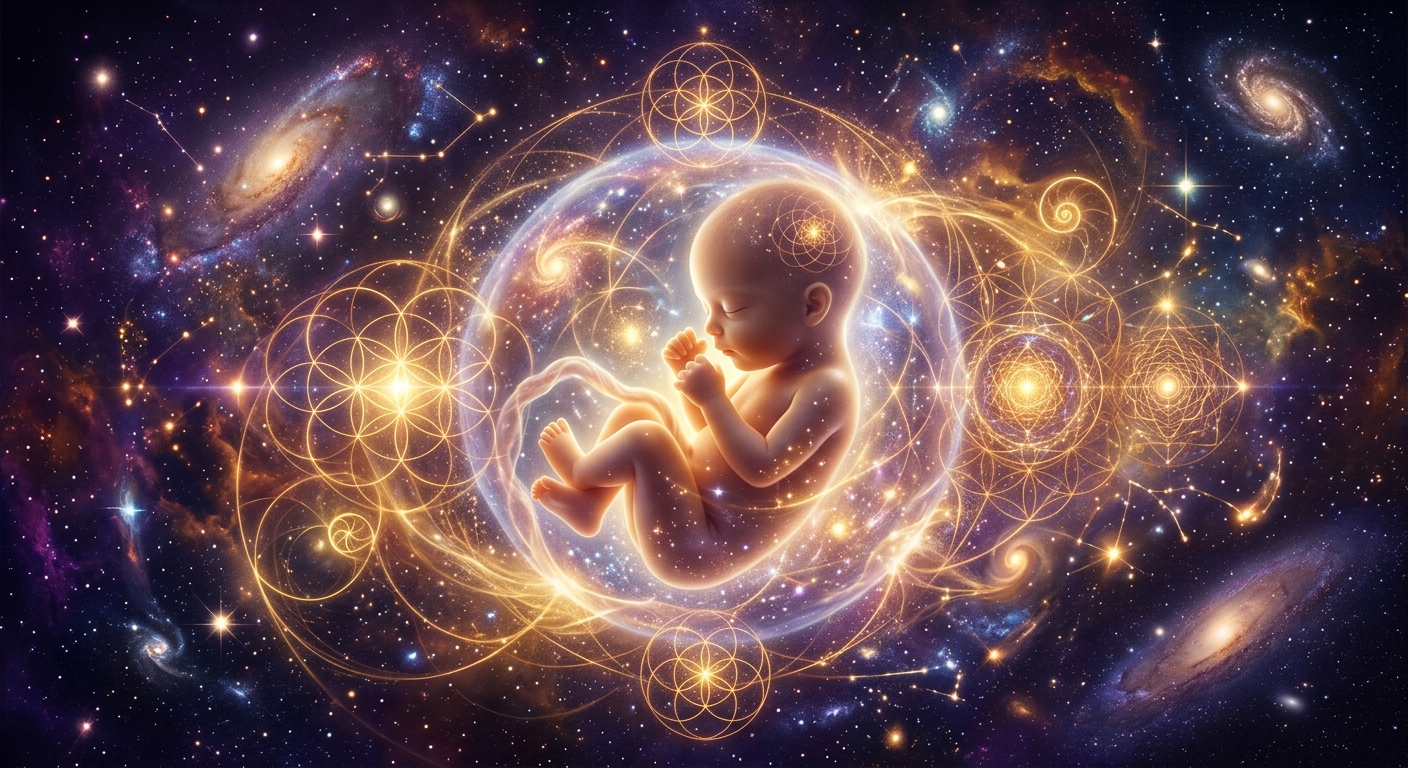
As a metaphor, this relationship may be compared to the scientific idea of quantum entanglement. Quantum entanglement describes a profound connection between particles at the quantum level. Similarly, in the spiritual tradition, the mother and the unborn child are understood to share an exceptionally deep bond—not merely biological, but emotional, psychological, and spiritual. This comparison is symbolic and philosophical, not a scientific equivalence.
The mother is therefore not simply nurturing a body; she is cultivating an environment in which consciousness can express its highest potential. Her peace becomes the child’s peace. Her compassion becomes the child’s first lesson in love. Her discipline, devotion, and purity become the subtle impressions that help shape the child’s character.
Just as the quality of soil, water, and sunlight determines how a seed grows into a tree, the quality of the mother’s inner world profoundly influences the unfolding of the child’s life.
"The mother’s womb is a sacred universe where nature fashions the body, love nourishes the heart, values shape the character, and consciousness gradually reveals itself through human life."
Divine Progeny Creation
The Scientifically Informed Vedic Process of Garbha Sanskar (Prenatal Spiritual Nurturing)
Introduction
In the Indian spiritual tradition, the conception of a child has never been regarded as merely a biological event. Rather, it has been viewed as a sacred process of nurturing dharma (righteousness), values, consciousness, and character.
The ancient sages taught that when prospective parents prepare themselves through purity of thought, a disciplined lifestyle, spiritual practices, and a sattvic (wholesome) way of living before and during pregnancy, the unborn child may receive noble impressions (sanskaras) even while in the womb.
Prahlada
One example is Prahlada, who, according to tradition, received the teachings of the sage Narada while still in his mother’s womb and later became an exemplary devotee of Lord Vishnu.
Abhimanyu
Another well-known example is Abhimanyu, who is traditionally believed to have learned the strategy of entering the Chakravyuha formation by listening to the conversation of his father, Arjuna>, during pregnancy.
Whether understood symbolically or literally, these traditional narratives emphasize the importance of the prenatal environment and suggest that a mother’s thoughts, emotions, surroundings, nutrition, and spiritual practices during pregnancy may influence the child’s development.
The Vedic Tradition of Divine Progeny
The Vedic tradition describes sixteen sacred rites (Shodasha Samskaras) that sanctify the different stages of human life. The first three are directly related to conception and pregnancy.
(1) Garbhadhana Samskara
(The Rite of Sacred Conception)
This is the sacred rite through which a husband and wife consciously resolve to welcome a child.
- • Cultivating purity of mind and noble intentions
- • Offering prayers to the Divine
- • Preparing oneself to receive a virtuous soul
This rite teaches that the birth of a child is not merely a biological event but also a conscious spiritual responsibility rooted in intention and inner awareness.
(2) Pumsavana Samskara
Traditionally performed during the early stage of pregnancy, this rite is intended to support the well-being of both the mother and the unborn child.
- • Praying for the healthy development of the unborn child
- • Promoting the mother’s emotional peace and mental well-being
- • Creating a positive spiritual atmosphere throughout pregnancy
According to the traditional understanding, the mother’s emotional state and spiritual environment are especially important during this period.
(3) Simantonnayana Samskara
This rite is traditionally observed during the middle stage of pregnancy.
- • Supporting the mother’s emotional balance
- • Creating a joyful and peaceful environment
- • Encouraging spiritual recitation, sacred music, and uplifting company
Nurturing the mental equilibrium and happiness of the expectant mother with spiritually elevated environments.
The Spiritual Practice of Garbha Sanskar
Parents who wish to nurture virtues such as wisdom, courage, compassion, self-discipline, and devotion in their future child may choose to cultivate a spiritually uplifting environment during pregnancy.
1Mantra Recitation and Prayer
- The Gayatri Mantra
- Repetition of the Divine Name
- Listening to Vedic chants
Within the Vedic tradition, sacred sound is regarded as a means of cultivating inner peace and spiritual awareness.
2Study and Listening to Sacred Scriptures
- The Bhagavad Gita
- The Upanishads
- The Ramayana
- The Mahabharata
These scriptures are valued for promoting peace, wisdom, ethical reflection, and spiritual inspiration.
3Meditation and Yoga
- Gentle breathing exercises (Pranayama), when medically appropriate
- Meditation
- Listening to calming music
These practices may help reduce stress and support the mother’s emotional well-being.
4Sattvic Lifestyle and Nutrition
- Fresh and nourishing food
- Fruits, milk, and wholesome dairy products, where appropriate
- Avoiding intoxicants
- Cultivating emotional balance and minimizing anger and negativity
A Scientific Perspective
Modern science includes a field known as Epigenetics, which studies how environmental factors can influence the activity of genes without altering the underlying DNA sequence.
- • Maternal nutrition
- • Emotional well-being
- • Stress levels
- • Environmental conditions
can influence fetal development.
Similarly, studies indicate that prenatal exposure to music, language, and reduced maternal stress may contribute positively to aspects of early brain development.
The Ideal of Divine Progeny
According to the Vedic tradition, parents seeking to cultivate noble qualities in their future child are encouraged to focus on five foundational principles:
Conclusion
Indian spiritual tradition regards every child as a sacred gift of the Divine.
When parents approach pregnancy as a period of conscious preparation, spiritual growth, and ethical living, they create an environment that nurtures the physical, emotional, intellectual, and spiritual development of the unborn child.
Thus, Garbha Sanskar is understood not merely as an ancient cultural tradition but as a holistic approach to prenatal care that integrates spirituality, ethical living, emotional well-being, and conscious parenting. While many of its spiritual claims belong to the domain of faith and tradition, its emphasis on a healthy, peaceful, and nurturing prenatal environment resonates with several principles recognized by modern developmental science.

From the Womb toConsciousness
In the Indian spiritual tradition, it is believed that the child in the womb is not merely a developing body; it is also undergoing the unfolding of consciousness, values, and emotional impressions. The mother’s nourishment, thoughts, emotions, environment, and the sounds she experiences all become part of the unborn child’s world of experience.
In Bhagavad Gita, Lord Krishna explains that the soul changes bodies just as a person discards worn-out garments and puts on new ones (Bhagavad Gita 2.22). From this perspective, birth is not viewed merely as a biological event but as the beginning of a new journey of consciousness.
A Symbolic Connection with Quantum Entanglement 🌌
Quantum science teaches that, at the microscopic level, certain particles can share a profound connection. Inspired by this idea, one may draw a symbolic and philosophical analogy that the bond between a mother and her unborn child is not limited to the physical body; it also encompasses emotional, mental, and spiritual dimensions.
- • The relationship between the mother and the unborn child extends beyond biology to include deep emotional and psychological connection.
- • The mother’s peace, love, positive emotions, and surrounding environment may influence the child’s development.
- • Practices such as Vedic chanting, sacred music, meditation, yoga, and prayer help cultivate a calm, harmonious, and nurturing state of mind for the mother.
Garbha Sanskar is the sacred process of creating a positive environment for the mother—physically, mentally, emotionally, and spiritually—through pure thoughts, selfless actions, yoga, meditation, and Vedic mantras. Its purpose is to nurture the seeds of noble values and virtues within the unborn child.
Just as everything in nature is interconnected through subtle and often invisible relationships, the bond between a mother and her unborn child may also be understood as a sacred bridge of love, consciousness, and inner awareness. This comparison to quantum entanglement is intended as a philosophical metaphor rather than a scientific equivalence.
The Classical Month-by-Month
Development of the Fetus
Ancient Indian Ayurvedic literature and traditional scriptures describe fetal development with remarkable detail. Descriptions are found primarily in the Charaka Samhita, Sushruta Samhita, and the Srimad Bhagavatam. The following reflects the traditional Vedic understanding of pregnancy, along with suggested spiritual practices for each month.
"Kalalaṁ tveka-rātreṇa pañca-rātreṇa budbudam."
According to the traditional description, the embryo initially exists in a subtle fluid-like state and gradually begins to take form.
- • The mother should remain calm and emotionally peaceful.
- • Engage in daily remembrance of God through prayer or meditation.
- • Follow a wholesome, sattvic diet.
"Dvābhyāṁ piṇḍaḥ prajāyate."
During the second month, the embryo is traditionally described as developing into a more defined embryonic mass.
- • Cultivate positive thoughts.
- • Speak gently and kindly.
- • Avoid anger, stress, and emotional disturbances.
"Hasta-pādādayaḥ sarve kramaśaḥ sampravartate."
According to the traditional understanding, the formation of the limbs and major body structures begins during this stage.
- • Listen to inspiring stories of great saints and noble personalities.
- • Maintain an uplifting and spiritually positive environment.
This month is traditionally associated with the further development of the heart and the awakening of consciousness.
- • Cultivate love and compassion.
- • Practice devotion and gratitude.
- • Maintain emotional harmony.
This stage is traditionally associated with the development of the mind and emotional awareness.
- • Read or listen to the Bhagavad Gita.
- • Practice meditation regularly.
- • Maintain a peaceful state of mind.
According to classical tradition, this period is associated with the development of the senses and intellectual faculties.
- • Listen to Vedic mantras.
- • Spend time in a calm, peaceful, and spiritually uplifting atmosphere.
- • Avoid unnecessary stress and negativity.
According to the Srimad Bhagavatam, the unborn child is described as becoming increasingly conscious of its existence during this stage.
- • Participate in satsang (spiritual gatherings).
- • Practice regular chanting of the Divine Name.
- • Strengthen devotion through prayer.
The baby’s body is traditionally considered to become more mature and prepared for birth.
- • The mother should maintain emotional stability.
- • Remain cheerful, optimistic, and relaxed.
- • Continue meditation and devotional practices.
The baby is considered fully prepared for birth.
- • Offer daily prayers.
- • Maintain pure and auspicious thoughts.
- • Prepare mentally and spiritually to welcome the child with love, peace, and gratitude.
Divine Garbha Sanskar Ashram
Where Character, Consciousness, and a Noble Life Begin in the Womb
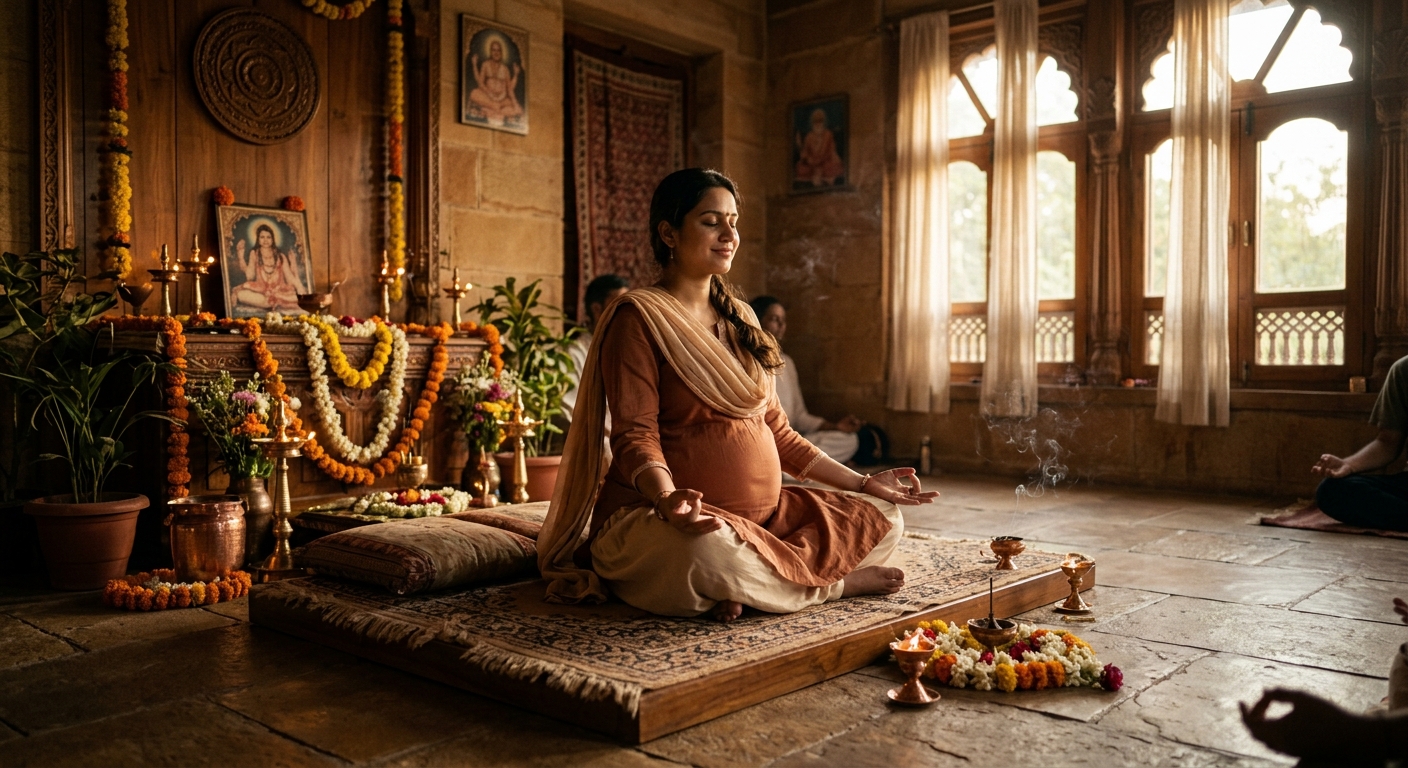
In the ancient Vedic tradition of India, the womb is regarded not merely as the place where a baby’s body develops, but as a sacred opportunity to nurture the character, values, and consciousness of the next generation.
According to this traditional understanding, a mother’s thoughts, emotions, nutrition, environment, and spiritual practices during pregnancy may influence the development of her unborn child. Inspired by this Vedic vision and presented in harmony with modern life, the Divine Garbha Sanskar Ashram offers a carefully structured spiritual wellness program for expectant parents.
Our Mission
Our mission is to help cultivate future generations endowed with:
- Excellent health
- A radiant and discerning intellect
- A calm, balanced, and peaceful mind
- Courage, confidence, and resilience
- Compassion, noble values, and good character
- A sense of moral responsibility, service, and love for society and the nation
What Happens at the Ashram?
Vedic Garbha Sanskar Sessions
Experienced Vedic teachers and trained women facilitators provide guidance to expectant mothers based on traditional Garbha Sanskar practices.
- Listening to Vedic mantras
- Guided meditation
- Positive affirmations and conscious intention
- Spiritual reflection and self-awareness
Sacred Mantra and Sound Meditation
In the Vedic tradition, sacred sound is regarded as a powerful medium for cultivating inner peace and spiritual awareness.
- • Vedic mantra chanting
- • Devotional prayers
- • Peace invocations
- • Gentle meditative music
These practices are intended to create a calm, uplifting, and spiritually enriching environment.
Prenatal Meditation and Yoga
Under expert guidance, expectant mothers participate in gentle yoga and meditation practices designed to promote:
- Mental calmness
- Emotional balance
- Positive inner energy and relaxation
All practices are intended to complement, not replace, appropriate medical prenatal care.
Conscious Parenting & Family Values
Garbha Sanskar is viewed not only as the mother’s journey but also as a shared responsibility of both parents.
- • Creating a spiritually uplifting home environment
- • Developing positive and compassionate communication
- • Cultivating noble intentions and loving connection with the unborn child
A Nine-Month Guided Spiritual Journey
The Ashram offers a structured month-by-month program that accompanies parents throughout pregnancy.
- • Spiritual practices and meditation
- • Mantra recitation and contemplative listening
- • Lifestyle and emotional well-being guidance
- • Traditional Vedic observances
- • Conscious preparation for welcoming the child with love, peace, and gratitude
Our program seeks to support parents in making pregnancy a period of personal growth, mindful living, and spiritual enrichment while encouraging appropriate medical care throughout the prenatal journey.
6. Conclusion
Garbha Sanskar is understood not merely as an ancient cultural tradition but as a holistic approach to prenatal care that integrates spirituality, ethical living, emotional well-being, and conscious parenting.
While many of its spiritual claims belong to the domain of faith and tradition, its emphasis on a healthy, peaceful, and nurturing prenatal environment resonates with several principles recognized by modern developmental science.
Our Inspiration
According to the Indian spiritual tradition,
Prahlada, one of the greatest devotees of Lord Vishnu, is traditionally believed to have received the sacred teachings of Sage Narada while still in his mother’s womb, nurturing within him the values of devotion and righteousness even before birth.
Similarly, Abhimanyu, according to the Mahabharata, is traditionally believed to have learned the strategy of entering the Chakravyuha battle formation while in his mother’s womb by listening to his father, Arjuna.
Whether understood as sacred history or symbolic teachings, these traditional narratives inspire us to treat pregnancy as a precious period to cultivate positive thoughts, noble values, and spiritual awareness.
“If we wish to transform society, we must first nurture the values of the next generation.”
And that journey begins—
Not only in a mother’s arms, but first within a mother’s womb.
Become a Part of This Divine Journey
Give your unborn child not merely the gift of birth,
but also the foundation of noble values, awakened consciousness, inner peace, and a purposeful life.
“Nurturing Noble Values in the Womb, Illuminating Life for the Future.”
Note: Our spiritual programs are designed to complement, not replace, professional prenatal medical care. All expectant mothers are encouraged to continue regular consultations with their qualified healthcare providers throughout pregnancy.